
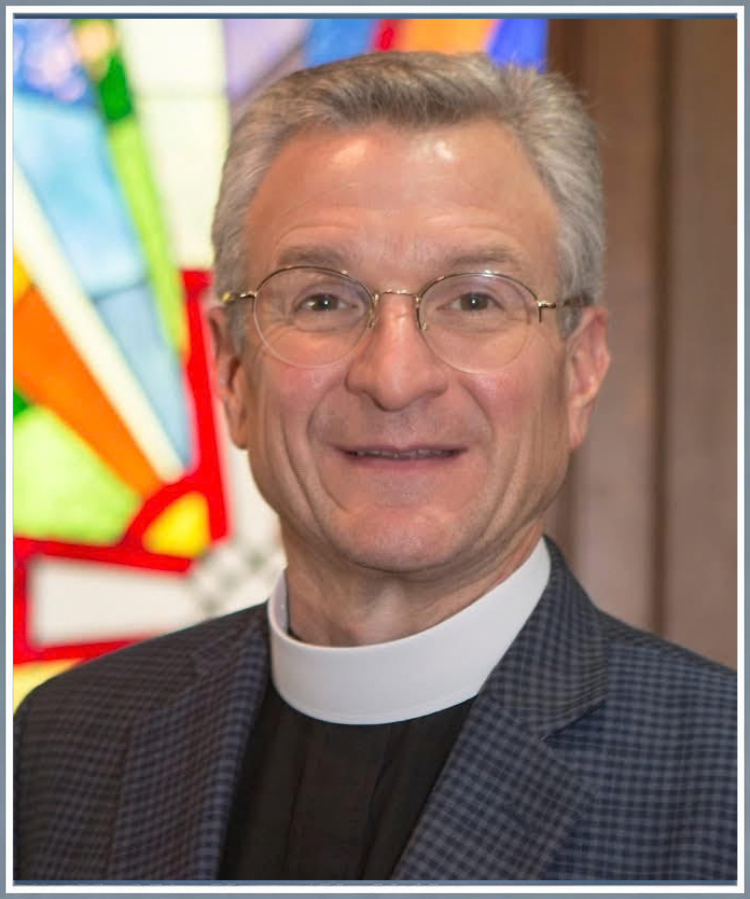
 The Rev. Christopher B. Thomas
You say it yourself, so eloquently, in your beginning; if I am to understand you, the place to start is with wind, the very breath sweeping across the Llano Estacado, "the staked plains." That wind, the very breath of God, at once gentle, sometimes violent, is itself a mix of contradictions, never beginning, never ending, Alpha and Omega, those points where it meets you on the plains, staked forever as holy incarnations, the places where you meet God, the God who loves you to, loves you in, and loves you through, all that desert life holds.
The curious, grateful thing about wind is that no one owns it. Wind did not start on the staked plains or end there. The very same breath blew forward across the bayous and swamps of south Louisiana, deep into the heart of Acadiana. It was there that, in spite of all signs to the opposite, I myself found the open arms of God breathing love and life through tiny little Trinity Episcopal Church, in Morgan City, Louisiana. For it was there that I met the God of acceptance and embrace, not the God of judgment and rejection. Although it was never specifically enunciated this way, what I found, through the doing of Anglican theology, in that blessedly tiny, shamelessly bold parish in the swamp, was Grace.
"Twas Grace that taught my heart to love, and Grace my fears relieved… "
The Grace that rides on wind is so incredibly intoxicating that I have devoted my entire life to this calling, this crazy institution we call The Episcopal Church. For it was only by Grace that I got to meet this God; it is only by Grace that I survived; it is only by Grace that I am here and breathing. Should not everyone have the same opportunity to meet this God?
How do I do that? How do we do that? For Episcopalians like you and me, it is discernment. What would God call us to do? What is the next right thing? What are all the collections of "next right things" that compel Grace forward?
What was it about the doing of Anglican theology (scripture, tradition, reason; our beloved three-legged stool), living in the questions rather than always having the answers, that made those 30 people in the swamp so well-equipped to be God's Grace personified? Living in the question, rather than always having to have every single answer opens up the spaces between the concrete places of the world for Grace to blow through.
The joy of living in the question is that it makes space for, quite literally, everyone. The frustration of living in the question is that it makes space for, quite literally, everyone. It is Grace, when everyone is there.
How do we get everyone to Grace?
Two pillars have emerged as hallmarks of my ordained ministry, two guiding emphases, the baptismal covenant, and the unique Anglican notion of "real presence." The baptismal covenant spells out, in no uncertain "doing" terms the actions that each of us, through our baptismal ordinations, are expected to carry out if we are to bear the identity of Jesus Christ. The five questions are as simple as the Great Commandment (love God, love neighbor, love self), and as complex as integrating the Great Commandment into the broken world all around us. The baptismal covenant forces us to confront our own brokenness and the brokenness of the world, and it guides the way to Grace. It is why I strongly recommend my parish to pray it twice every single day – once in the morning as aspiration, and once in the evening as evaluation. It is what forms us into the identity of Jesus Christ.
Secondly, I am convinced that "real presence" is our unique Anglican secret sauce, the mysterious, mystical way that we incarnate Jesus Christ every single time we gather, two of us, ever increasing to all, in our God-inspired liturgies. We take everything that we are, everything that we have, everything that we want to be, everything that the wind blows in, across the waters of the baptismal font, right up onto the altar, say some words over it, break it, and give it back to take out into a broken and hurting world! That is nothing short of miraculous!
All of that is hard work, doing the baptismal covenant, showing up and being real presence.
It is hard work, and yet so necessary, because each of us, all of us, is so very similar, and yet so completely unique. Each one of us, all of us, bear the imprimatur, the Imago Dei, the image of God. If we have any hope of knowing the God of our Creation, we must look at ALL of those little God-pieces around us, the ones that look like us, and the ones that do not. It's the ones that do not that are the challenge. The ones that do not look like us, or smell like us, or sound like us, or believe like us, or vote like us, those are precisely the ones that we are needing to complete the picture.
We do not do this work to save them or to save us. (We have a savior, and it is not us!)
We do this work to introduce them and us, all of us, to Grace.
Grace is the necessity that resides in the tension of justice and mercy. Grace gives elasticity to the ever-ongoing dynamic pull of justice and mercy. Grace makes listening possible.