An error has occurred. Please try again.

Loading...
The Stars at Night Are Big and Bright Deep in the Heart of Texas
Diocesan News
 The Stars at Night Are Big and Bright Deep in the Heart of Texas The Stars at Night Are Big and Bright Deep in the Heart of Texas….or at least they are in some places. We, who live in the vast expanse of the Diocese of Northwest Texas, are lucky for many reasons and one is there are still places where you can stargaze without city lights obliterating the heavens. For millennia, human beings have gazed into the firmament and been awed by the thousands of stars, galaxies, nebulae, and other cosmic wonders visible to the naked eye. But in recent generations, much of humanity has become divorced from these marvels. Today, at least 80 percent of people living in the United States and Europe are so inundated with light pollution that they can’t even see our own Milky Way, let alone our neighboring galaxies like Andromeda.
Light pollution not only blocks the view of the Milky Way for more than 80 percent of Americans, 99 percent now live under skies with at least some light-pollution impact. Even rural areas, far from major cities, are increasingly affected by small but brightly lit towns, industrial facilities, or other developments. To see truly dark skies, free from any detectable artificial light, one must travel sometimes great distances. Our own Big Bend area and the Davis Mountains of Texas where the McDonald Observatory is located is one place where the stars are, indeed, big and bright.
According to the University of Texas at Austin’s McDonald Observatory and their publication, Star Date, “Poor outdoor lighting blots out the universe, impacting science, wildlife, and human health.” There are ways that outdoor lighting can illuminate the ground without masking the stars.
Beyond blocking humans views of the stars dark skies are important for the overall health of our ecosystem. Migratory birds are often killed in flight when they are confused and lured off-course flying into sky scrapers sending bright lights into the night sky. Bats, one of our best protection against mosquitoes, can starve to death because of light pollution as they won’t fly and search for food when there is constant light. Even mammalian wildlife suffers because of light pollution. There are many predator species that are chiefly nocturnal that are dwindling in numbers because of artificial lighting confusing their circadian rhythms. All of these factors and more can upset the natural biological systems in our environment.
Humans evolved to the rhythms of the natural light/dark cycle of day and night. The proliferation of artificial light at night means most of us no longer experience truly dark nights. Many studies have shown that exposure to artificial light at night negatively affects human health, including increased risk for: Sleep Disorders, Depression, Obesity, Diabetes, Heart Disease, and Cancer. Recent studies have even linked the lack of a light/dark cycle in human beings to the development of Alzheimer’s.
As you can see, there are many reasons to advocate for dark skies. And many sources to help you do this. Not only can you advocate for lighting in your cities that shields the sky directing light to the ground where it is needed. There are ways that we can preserve dark skies in our own backyards. For example, we can direct our patio lighting to the ground in many aesthetically pleasing ways that does not affect the sky or your neighbors views of the sky.
The towns of Marfa, Alpine, and Fort Davis in the Big Bend area have all embraced The Dark Sky Initiative and have ordinances requiring businesses and homes to direct their lights to the ground and not into the night sky. For Alpine this is a source of pride. Even though Alpine is not within the McDonald Observatory area that requires dark sky lighting, as is required in Marfa and Fort Davis, having lights that comply allows people to just look up anywhere they might be and see the awe inspiring night sky of the Alpine area.
West Texas is far from the only place taking steps to preserve the night sky. Flagstaff, Arizona, with a population of more than 100,000, was named the world’s first International Dark Sky City in 2001. Even larger cities, Such as Pittsburgh and Los Angeles County, have taken steps to reduce pollution from city streetlights, citing improved energy efficiency, safer driving conditions, and reduced environmental impact.
Listed below are a few organizations and website you can access for more information about the Dark Skies Initiative: 1. darksky.org; 2. you can participate in the Globe at Night community science project and help measure light-pollution in your area through globeatnight.org; 3. McDonald Observatory’s Dark Skies Initiative at give.utexas.edu (keywords: Dark Skies Initiative.
As our Eucharistic Prayer C states, At your command all things came to be: the vast expanse of interstellar space, galaxies, suns, the planets in their courses, and this fragile earth our island home….
Let us go forth into the world and help save our dark skies!
Peace to all,
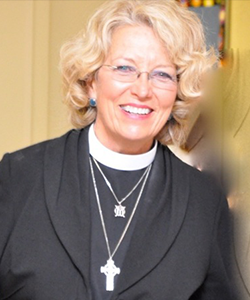
Rev. Becky Tilton Orem - Deacon, St. Paul’s on the Plains, Lubbock